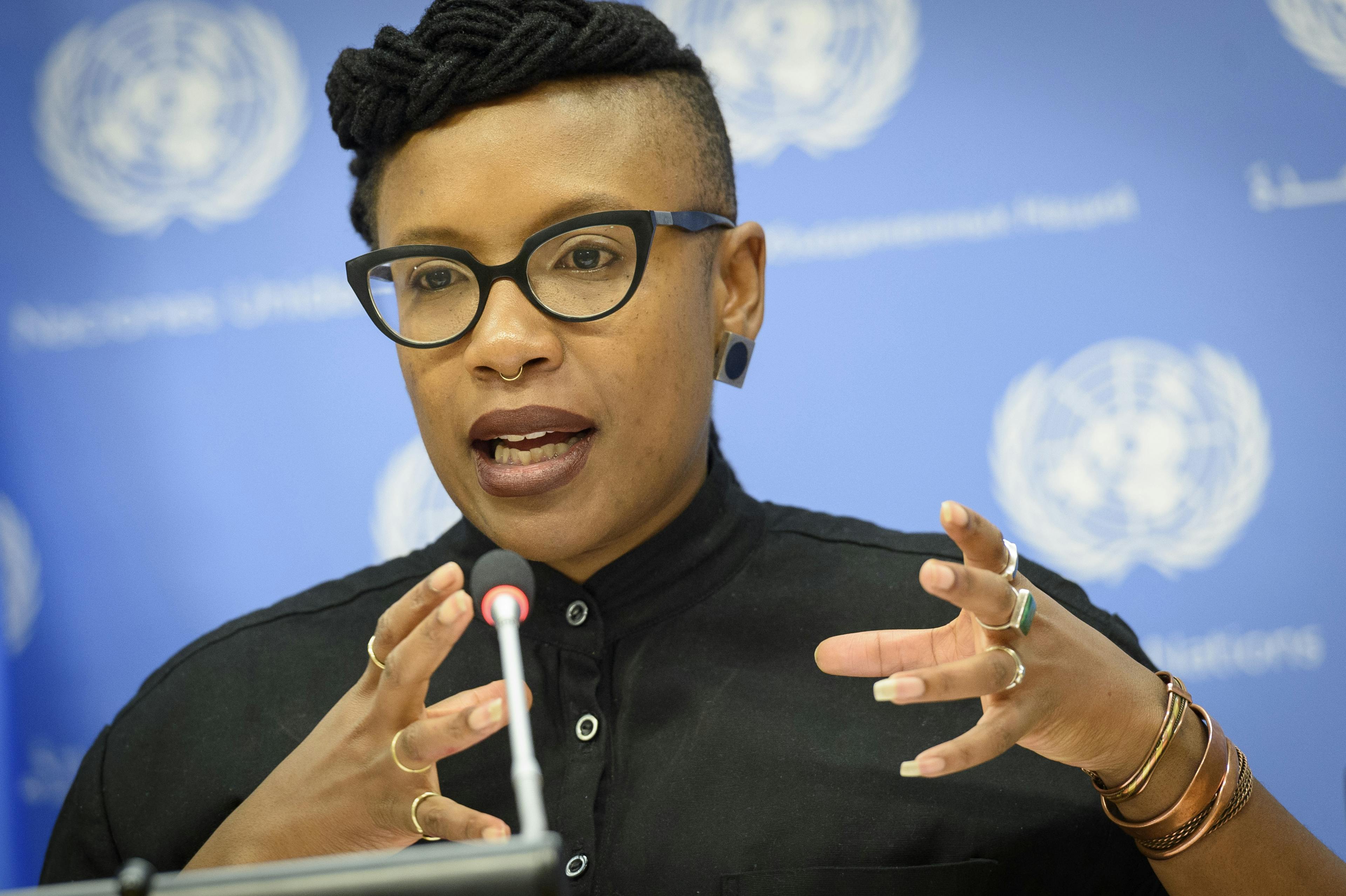
Tendayi Achiume
When Tendayi Achiume (AC’01) looks back on her journey, from a science-focused student in Zambia to an international legal scholar and UN Special Rapporteur, she traces a clear beginning: UWC Atlantic.
“UWC changed the way I understood the world and changed the way I understood myself,” she reflects. “I loved the freedom that AC gave us and the trust they put in us to figure out who we were… and make sense of the world that we were in.”
Arriving at Atlantic College with plans to become a physicist or engineer, Tendayi took Higher Level subjects to reflect that. But the College’s educational diversity through the IBDP opened an unexpected door. Electing to take Standard Level Political Thought and studying the works of Hobbes, Locke and Machiavelli captivated her. “It was probably the opening up of the window that I then scrambled through to what I ended up focusing on.”
This curiosity sparked at AC stayed with her. Although she had never considered studying in the United States, exposure to new academic pathways at AC led her to apply, ultimately enrolling at Yale. There, she pursued the questions first awakened at UWC Atlantic – questions about her place in the world and how she could contribute to meaningful change. “I decided I was going to spend the first year entrenching myself in the humanities and social sciences before pivoting to the natural sciences. This is where I felt best able to investigate the kinds of questions and themes that had been opened up for me at AC.”
Her move to delve into the humanities and social sciences made her realise the natural sciences was no longer a path she wanted to follow. Her evolving academic interests led her to law school, driven by a conviction that law could serve as a tool for social change. She entered human rights practice, working directly with refugees and asylum seekers. The work was meaningful, but emotionally devastating – she felt especially frustrated with legal frameworks that seemed to create barriers rather than advance the human rights they were intended to protect. Tendayi realised she needed a different way to contribute. Through this experience, Tendayi learned a crucial lesson she now shares with her students: “You have to find ways of being in the causes you care about that energise you, rather than make you feel really, really sad.”
“When I went to law school, I thought law can help with social change, and practicing as a lawyer, I also began to feel like law was actually part of the problem. It was structuring the harm that I was interested in fighting against.”
That insight led her toward academia and global policymaking. Combining scholarship and advocacy, she began influencing international human rights frameworks. Her dedication and expertise led to her appointment as UN Special Rapporteur on Contemporary Forms of Racism, Racial Discrimination, Xenophobia, and Related Intolerance from 2017 to 2022, where she tackled global issues of migration, racial justice and climate inequity on the world stage.
In her current work, Tendayi examines how colonialism, neo-colonialism and global power structures shape migration, borders and racial justice. She also teaches International Human Rights, Critical Race Theory and Third World Approaches to International Law, Borders and Migration at Stanford Law School.
Tendayi’s work bridges theory and practice, an approach she traces back to Atlantic College. “AC was a space for ideas, but also a space for practice,” she says. “Discovering that was something that I was into while I was there, I see a through-line now in my work.”
Ultimately, what UWC Atlantic gave her was a way of seeing: a curiosity about the world, a commitment to justice, and a belief that ideas themselves shape society. “I am in the world of ideas, but also committed to practice and policy. Ideas may be the most fundamental determinants of the world we live in.”
Today, Tendayi’s career continues to be defined by the questions first sparked in the classrooms at AC, questions that guide her work toward a more just global order.
“AC was a space for ideas, but also a space for practice. Discovering that was something that I was into while I was there, I see a through-line now in my work.”


